
People
Paul Nulty’s on the role of a Lighting Designer
When we hear the words ‘VE Day’, I’m sure most right-thinking people will process that as ‘Victory in Europe Day’ and get a warm feeling about our national heritage . . . plus a day off work! For those of us in the construction industry that is translated as Value Engineering Day, something to dread rather than celebrate, but it’s a fact of life we cannot ignore.
Some words sound stranger the more you say them and some word combinations sound stranger still. I asked my daughter what she thinks I might be talking about when I say ‘Value Engineering’. Bearing in mind she has designers for parents perhaps she has some form of genetic memory, a sensory understanding of what that word combination infers? Not at all. Like everyone else who’s normal, to her it sounds odd. My daughter’s interpretation is that it’s . . . ‘engineering that’s valuable, like cars’ . . . as opposed to making something that isn’t important. Fair enough.
I co-presented at Surface in February with Helen Berresford from ID:SR about some projects our practices had realised together. In the Q&A session, someone asked us about Value Engineering and I quoted someone who once said ‘It doesn’t deliver value and it’s certainly not engineering’. I checked online and can’t find the person to whom that’s attributed, but to me, it’s a sound definition. I thought that Value Engineering was a recent concept – or only coined in the last 10 or 15 years – but was surprised to find out that it’s been around since 1942 – just before Victory in Europe day in fact – by Larry Miles for General Electric. Owing to the war, it was necessary to research alternative materials because of limited supplies and ways of building products that were simpler with fewer skilled people and a huge demand for munitions.

Paul Traynor, Light Bureau
As a concept true Value Engineering does make sense – taking and improving the performance of something by studying it’s function and build, then producing an optimised product that actually improves the previous design. It’s hard to find examples of cheaper but better innovations that don’t just rely on mass production. How we all enjoy decent quality goods at prices we can afford, like our smart phones. In construction, building off site is a way to achieve good or consistent quality and, crucially, reduces time on site. Prefabricated pods for kitchens and bathrooms are commonly adopted in residential projects. The client doesn’t have to lose something or down-spec and the user gets a product they enjoy. So far so good.
But that’s not generally what takes place in construction projects when all the client’s hopes and aspirations and all the brilliance and innovation invested by the designer get stripped out of the scheme. In the same way, we don’t use the word ‘cheap’ preferring ‘cost-effective’. We don’t want to call this what it really is – which is cost-cutting.
Value Engineering is usually a standard deliverable now – a line item in the overall scope of services. Should it be? Or should it be an exceptional exercise because of some unforeseen change in circumstances? Projects are rarely conceived without there being a budget in place. If the budget is realistic then the design team’s responsibility is to work to it. If it’s unrealistic then we need to manage the client’s expectations which is hard – nobody wants to tell the client that it can’t be done – because it feels like failure to admit you cannot deliver the vision. But pretending it can be done is just storing up a bigger disappointment upstream. Sometimes budgets get lowered, or an event outside of anyone’s control, like Covid-19, and suddenly the programme, supply chain and demand are turned on their heads. The best we can hope for is that the project is not cancelled. In these situations, we accept the need to cut costs.

Building aspiration | Photo © Courtesy of Clivedale / Thomas Juul-Hansen
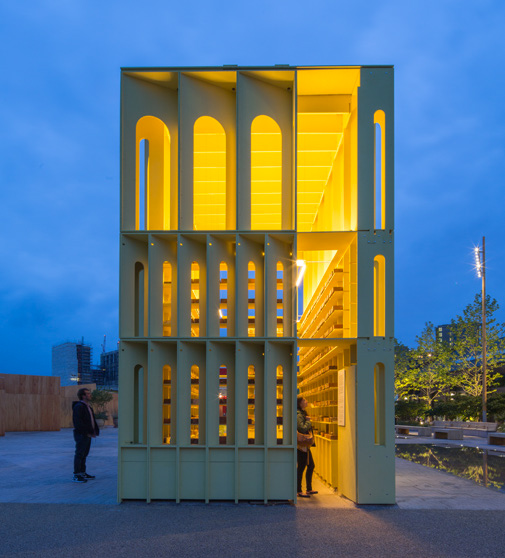
Hall McKnight’s Yellow | Photo ©Luke Hayes
Value Engineering shouldn’t happen during Stages 2 and 3 as long as the scheme is developing according to budget. It will typically take place when the credibility gap between the budgeted scheme and the tendered price is realised. In respect of lighting – and if the designer has done their job properly – the saving will be needed because the budget was wrong and not because it was over-specified or over-designed. In lighting, one of the most common methods of lowering cost is to reduce specification or to reduce quantity, or both. But if it’s possible to reduce specification and quantity without undermining the design, the design must have been wrong in the first instance.
In a well-conceived design, there will be sufficient light fittings to deliver the look and level, not more. If there is, for example, 20% more lighting being managed by a control system because the designer was lacking confidence or experience, then those additional fittings should not have been there in the first place. Unless the designer could have made the scheme work with lower priced fittings, there shouldn’t be any wriggle-room to swap out those originally specified for something cheaper, otherwise why would they have been chosen? So the question we should be asking of our client is ‘what are you prepared to sacrifice?’
At Light Bureau we’ve had to learn the hard way. One particular experience about six years ago saw us ruthlessly dumbing down our specification, but not reducing quantity as there was no fat in terms of redundant fittings. There was a lot of linear LED product specified as high quality. The product was good and so was the technical service from the supplier. In order to reduce budget and maintain the design intent, we re-specified to a ‘second-tier’ product – not as good but one we’d used successfully on a previous project. It was installed and by the time we snagged it, had begun to fail due to awful heat management. It was an enormous headache for specifier and contractor alike. Hundreds of metres of the product had to be replaced by the product we had originally specified. So, in the end, it cost more than twice as much – yet a good outcome in the circumstances.
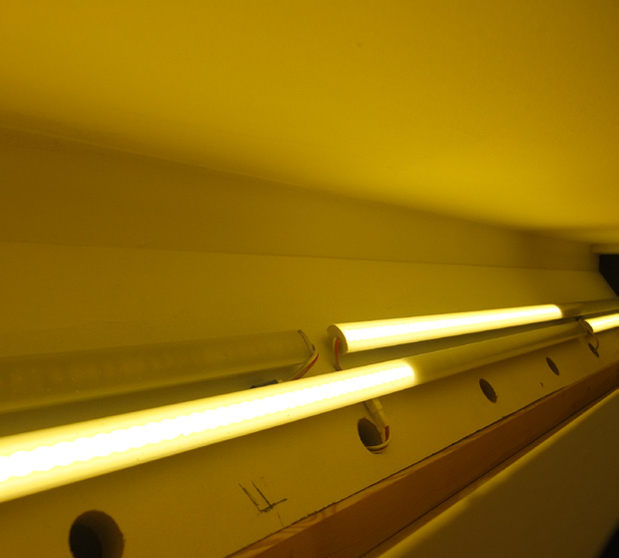
Products which are failing and need to be replaced | Photo ©Light Bureau
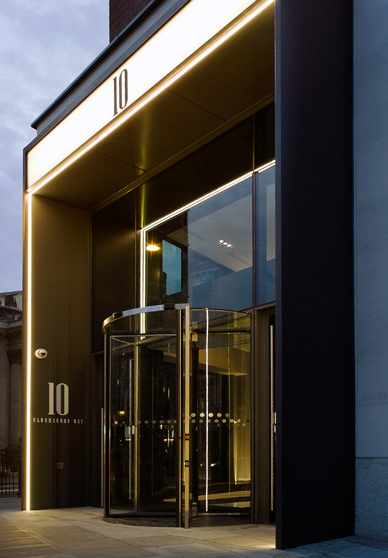
Good product integrated into portal doorway and sign | Photo ©Light Bureau
Ever since that experience, we now consider what feature to lose rather than what product to re-specify. It also taught us to be even more rigorous with our designs. We now curate and challenge each other when peer-reviewing our projects and if the designer cannot justify every single light source, then out it comes.
As Coco Chanel once said ‘Before you leave the house, look in the mirror and take one thing off.’
Now that’s good advice.
Paul Traynor, Founding Principal of Light Bureau
GET MORE INSPIRATION
Paul Nulty’s on the role of a Lighting Designer
Marino Furlan | Intra Lighting: The future of lighting is brighter